LSU’s Campus Mounds to begin first phase of preservation plan
This ancient monument has been a touchstone of student life 🐅🏞️
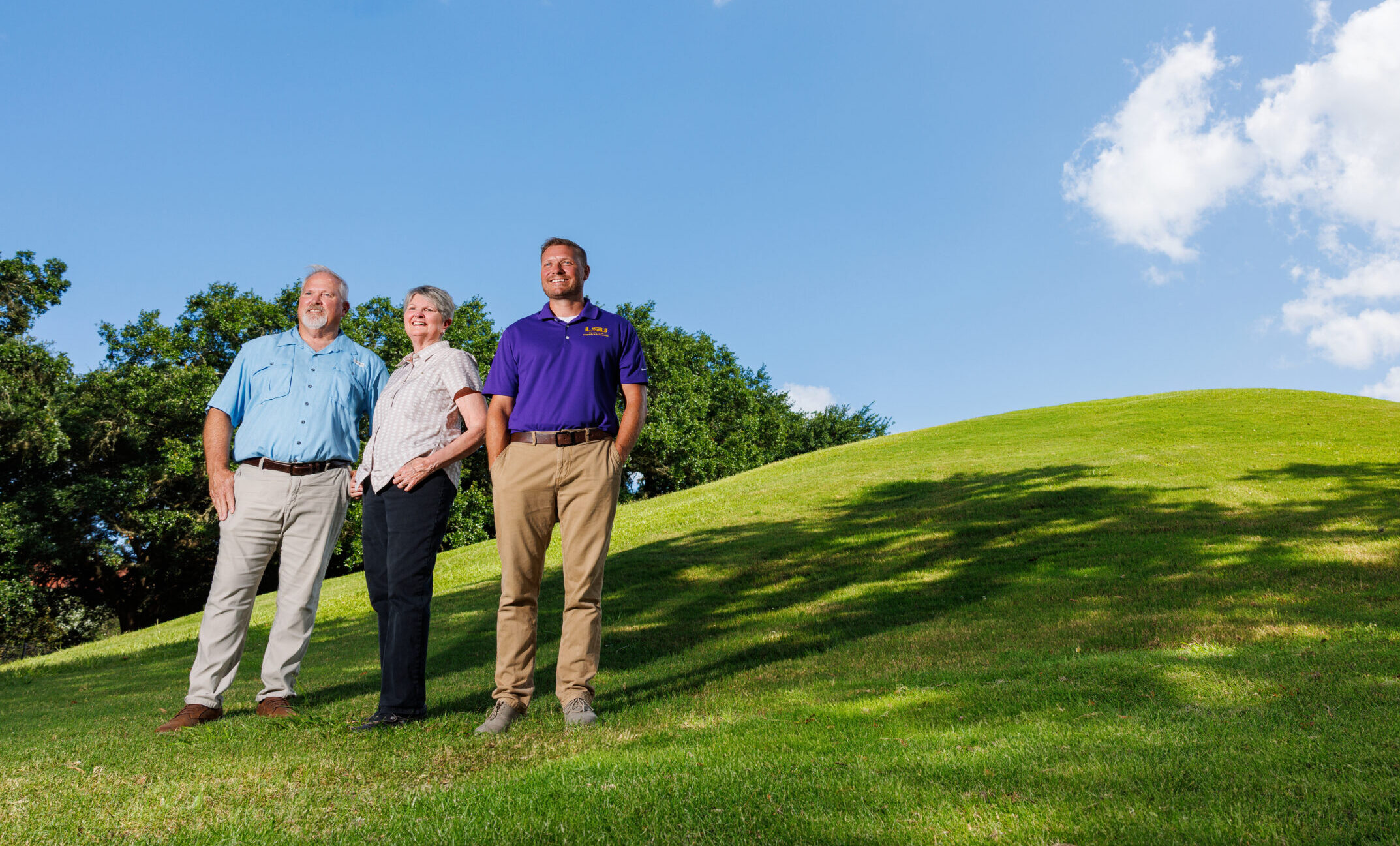
Dennis Mitchell is one of countless LSU alumni who considered ascending the university’s Campus Mounds a student ritual.
“I had a feeling then that it was my right to be able to go to the top of the mounds,” he says. “It was part of what I was supposed to do. It was human nature to want to do that.”
Mitchell has a lot of company. But today, he has a sharply different perspective. As LSU’s landscape architect, he’s part of a committee that has been working to preserve and protect the ancient manmade structures since 2020.
It’s an overdue effort, many say, but it has finally gained traction. A first phase of work intended to arrest erosion on the mounds starts this year, funded jointly by LSU and the National Park Service’s Save America’s Treasures program.
The Committee to Preserve the LSU Campus Mounds intends to raise additional money for future phases. Those include installing interpretive displays, replacing current fencing with something more visually appealing and adding new landscape features that create a richer visitor experience, Mitchell says.
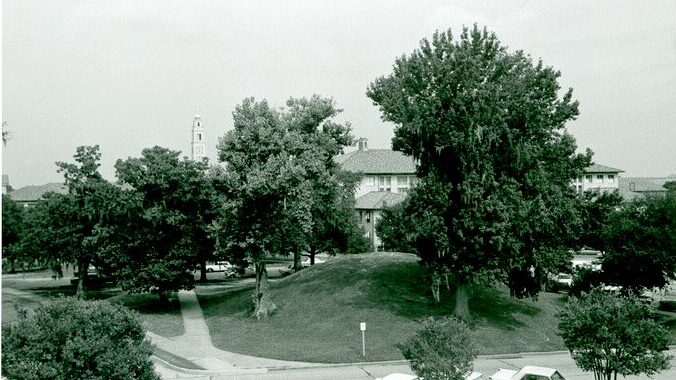
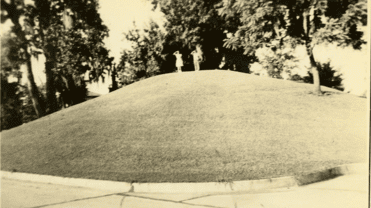
Considered a Middle Archaic site whose purpose isn’t fully understood, the Campus Mounds are unusual in their accessibility, says committee member and advisory archeologist Nancy Hawkins.
“There are very few Middle Archaic mound sites in the entire United States, and most are on private land in remote areas, often obscured by dense vegetation,” Hawkins says. “The Campus Mounds are extraordinary because they are in a city on public land.”
Hawkins says they are also among Louisiana’s oldest.
“There are only about a dozen mounds this old out of about 800 in the state,” she adds.
Just how old is the subject of ongoing, conflicting research.
In 2022, papers authored by two different groups of LSU scientists offered alternate interpretations of when the mounds were built. Retired Louisiana State Archeologist Chip McGimsey and Heather McKillop, the Thomas & Lillian Landrum Alumni Professor in the Department of Geography and Anthropology, co-authored a paper that determined the mounds are between 5,000 and 7,000 years old.
In another study, LSU Department of Geology and Geophysics professor emeritus Brooks Elwood suggested the mounds are 11,000 years old and one of the oldest existing structures in North America.
And in 2024, another research team led by LSU alumna Liz Chamberlain deployed optically stimulated luminescence to determine the age of the mounds. Those results are forthcoming and should offer conclusive data, Hawkins says.
But while historically significant, the mounds have also been an inadvertent touchstone of student life for decades. Ironically, what has been considered most “sacred” about them hasn’t been their ancient purpose, but their unwitting role as a student rite of passage. Scaling them, reclining with a book or sliding down them on a scrap of cardboard have been as commonplace as wearing purple and gold.
Until 2022, moves to restrict access have been limited. The first stemmed from a tragedy in 1984 when an intoxicated motorist drove over the mounds late at night, striking LSU student and Thibodaux native Elizabeth Courtenay Smoak, who died hours later from her injuries. In 1985, concrete posts were installed around the mounds to deter such behavior.
Foot traffic, however, would continue unabated for decades. Maybe it was the dearth of hills in largely flat south Louisiana, or the appeal of lounging on a natural incline, but the mounds continued to beckon—especially during LSU home games.
Efforts to deter pedestrian traffic during tailgating began in 2010 and were formalized in 2018 with temporary fencing and signage.
“We tried everything you can imagine to keep people off the mounds during gameday,” Mitchell says. “But they used the signs to slide down it. With the fencing, we watched parents pick up their kids and set them over it, so they could run around.”
But it was a freeze in the winter of 2021 that triggered demands to protect the mounds. An accumulation of snow and ice over a weekend drew sledders. One student even careened down the mounds in a kayak, according to The Reveille.
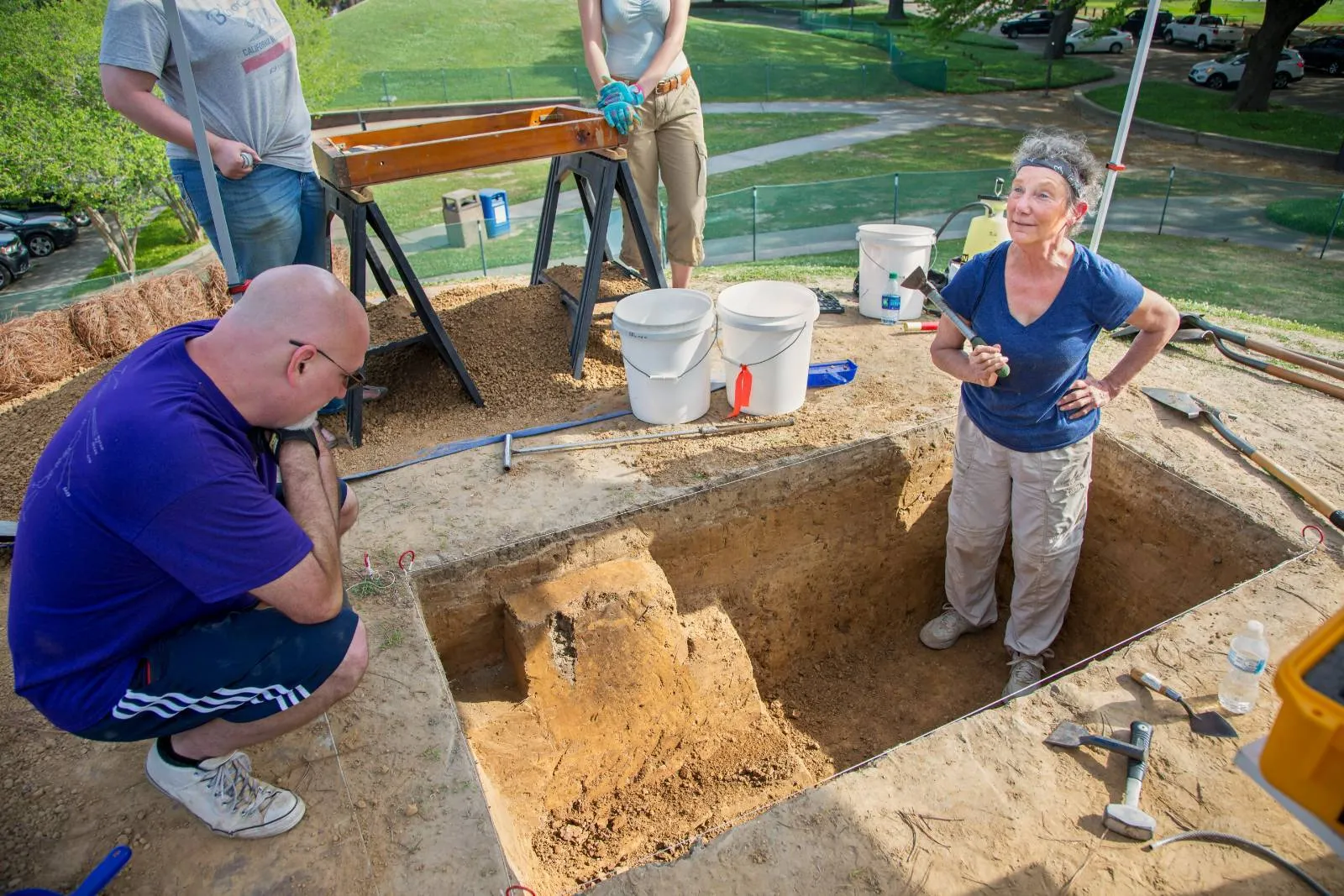
“There was a lot of damage on the surface and an outcry that we needed to protect the mounds,” Mitchell says.
A new, 6-foot black chain link fence was erected later that year. The preservation committee, formed in 2020, ramped up its efforts to source funding for restoration.
The first phase of work, supported by $442,000 from the National Park Service and LSU, will regrade the mounds and plant a fresh layer of drought-tolerant zoysia grass. Phase One will also install an irrigation system to keep the grass healthy.
“There are a lot of slumping areas that will be covered with improved soil and clay, and it will be revegetated with a more uniform grass that will do a better job of holding the soil and clay in place,” says committee chair and associate professor of geography and anthropology Kory Konsoer.
On a recent summer afternoon, a battery-operated robotic mower gently trimmed the patchy grass on the mounds’ surface. It’s a low-impact way to keep it from getting too high and going to seed. Work should begin this year on the restoration project, which will be completed within a few months, Mitchell says.
There’s still much work to be done in transforming the Campus Mounds to a protected site, but organizers say they’re encouraged.
“The fact that you’re seeing something that was built that long ago is just amazing,” Mitchell says. “I feel like we finally have some synergy.”
This article was originally published in the August 2026 issue of 225 Magazine.