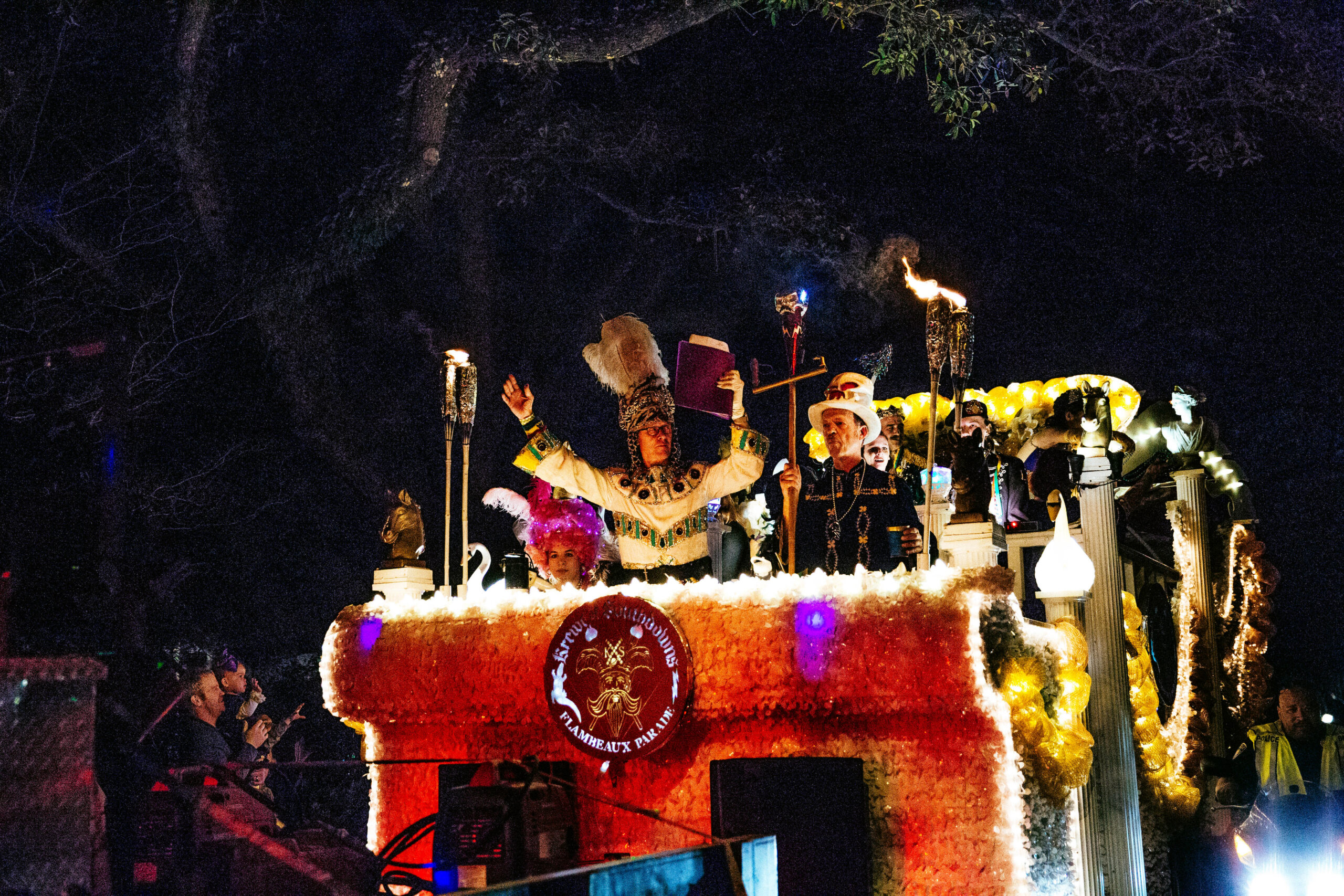
‘An experience unlike any other:’ What it’s like to march with the Krewe of Southdowns’ flambeaux line
It’s so much more fun to be in the parade than it is to watch the parade, Joe Simmons tells me. Simmons is the commander of the flambeaux line of the Krewe of Southdowns Mardi Gras parade, and this past Friday night, I learned firsthand this statement was not hyperbole.
The krewe invited me to walk with them in the Feb. 17 Mardi Gras parade, carrying one of the flambeaux torches that leads the way for its 50-plus marching and float units. Even for someone like me, who grew up in south Louisiana immersed in Mardi Gras, carrying a flambeaux was an experience unlike any other. It gave me a new perspective on the unique Louisiana tradition.
For more than three decades, the Krewe of Southdowns has entertained Baton Rouge residents both young and old with a homemade, community aesthetic not found anywhere else in the city. Perhaps its most unique tradition that sets it apart from the city’s other large parades like Spanish Town is the flambeaux line that lights the way with torches for the rest of the parade through the wooded streets of Southdowns.
The tradition dates back to late 1800s New Orleans Carnival, when illuminated torches would light the way for the rest of the parade before street lights lit the Crescent City’s streets. Watching the illuminated torches traditionally associated with New Orleans night parades light the parade as it rolls past St. Aloysius Catholic Church and the banks of the LSU Lakes is a rare a sight to behold.
This year’s Southdowns parade was all about these traditions, with a theme of Fetes de Louisiane, which is French for “Festivals of Louisiana.” Even before the parade rolled on Friday night, Glasgow Middle School’s parking lot was transformed into a welcoming microcosm of Louisiana’s rich culture. Groups dedicated to various festivals from across the state mingled, sharing local craft beer, whiskey, king cake and stories from across our region.
“Each area has its unique little spin,” says Tad Haller, the captain of the Mystic Krewe of Flambeaux. “We’re celebrating that diversity within our community.”
But as the parade rolled at 7 p.m. sharp, the celebration of many became one: a singular krewe made up of dozens of other krewes in celebration of Louisiana’s uniqueness.
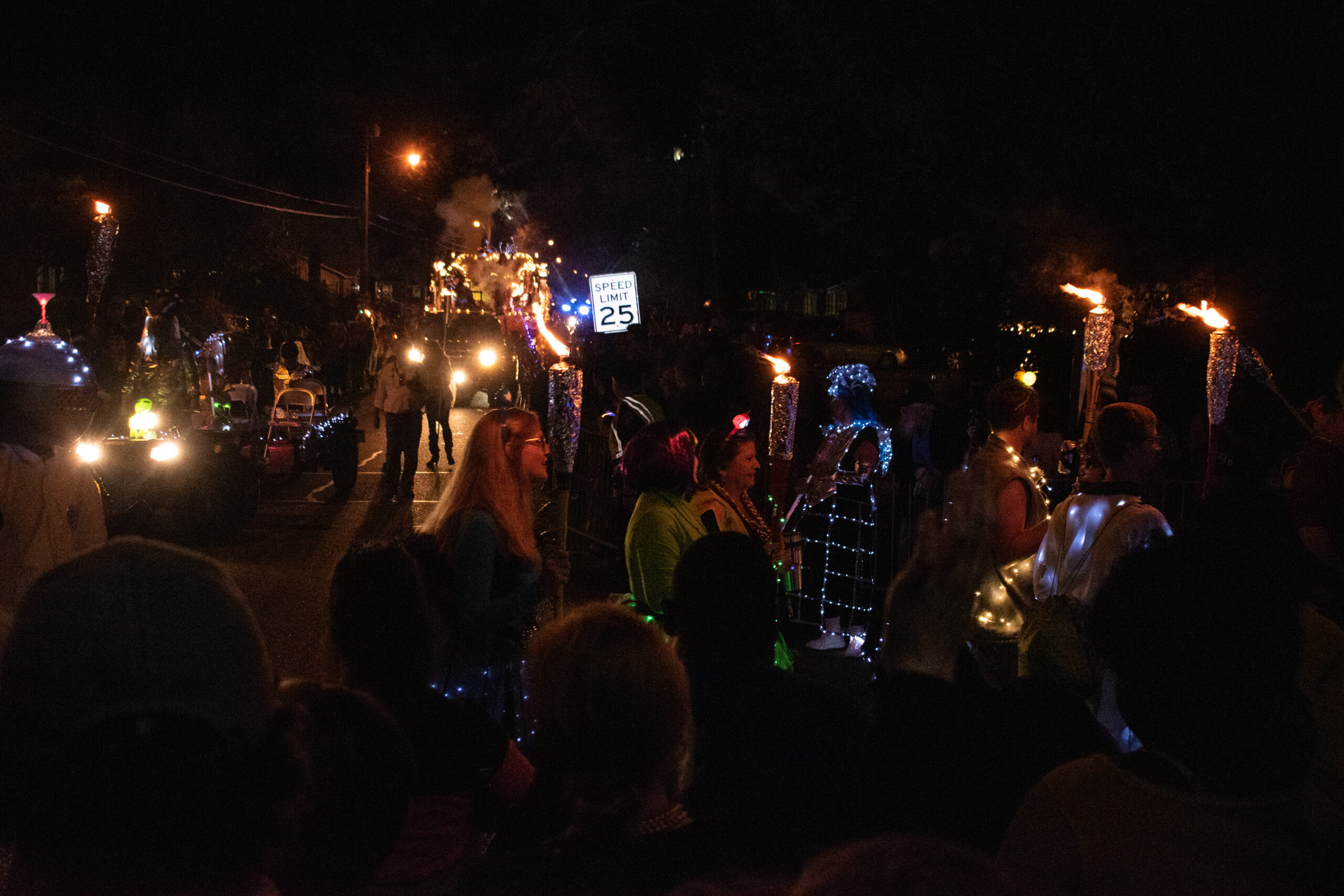
Leading this salute to Louisiana’s heritage was the flambeaux line. In New Orleans, these torches would be large metal apparatuses with fuel tanks; in Baton Rouge at the homemade Southdowns, they are tiki torches wrapped in foil.
“What really articulates the real spirit of Mardi Gras? There’s so many different facets and parts to it,” parade founder William Gladney says. “But the most mesmerizing were the torches, the flambeauxs and the night parades.”
As the parade crossed through the neighborhood of Southdowns, the flambeaux line was less of a regimented group marching in unison and more of a fraternity of friends, laughing, smoking cigars and making memories with one another as they passed doubloons out to their adoring fans, who watched from their yards as the cavalcade passed them by.
The Mystic Krewe of Flambeaux weren’t the only ones lighting the way through the crowd of excited college students, families and neighborhood residents. In front of the flambeaux line were the Dancing Girls, a tradition as old as the parade itself. They wore gowns representing Louisiana festivals, like Portland resident and Baton Rouge native Teresa Donich’s brightly lit and ornamented gown representing the Breaux Bridge Crawfish Festival. The Dancing Girls, ranging in age from 25 to 75, handed out doubloons and beads to children mesmerized by their illuminated beauty.
“We’re a family parade rolling through a neighborhood, at night, with all the lights,” Donich says. “We’re one of a kind.”
As the Dancing Girls moved to traditional Carnival music and pop tunes from across the decades, the atmosphere of community was reinforced as newcomers and veterans of the parade, dressed in the ornate costumes of Irishmen and pirates, shared stories and drinks as they laughed their way through the 40-degree weather.
As the parade met its terminus at the Acadian-Perkins Shopping Center, the krewe’s intended family-friendly environment where everyone was welcome, as one of the marchers told me, became apparent. The parking lot was a place of reunion to recall the experiences they just embarked on.
“Everybody is warm and welcoming,” says Haller, marching in the blue regalia of a French nobleman. “We’re not commercial. We discourage that.”
This community of openness, members says, is what really distinguishes the parade from others in Baton Rouge. It was all held together by a sense of family, both found and genetic, fueled by Mardi Gras’ celebration of the weird, the outlandish, and most of all, Louisiana.