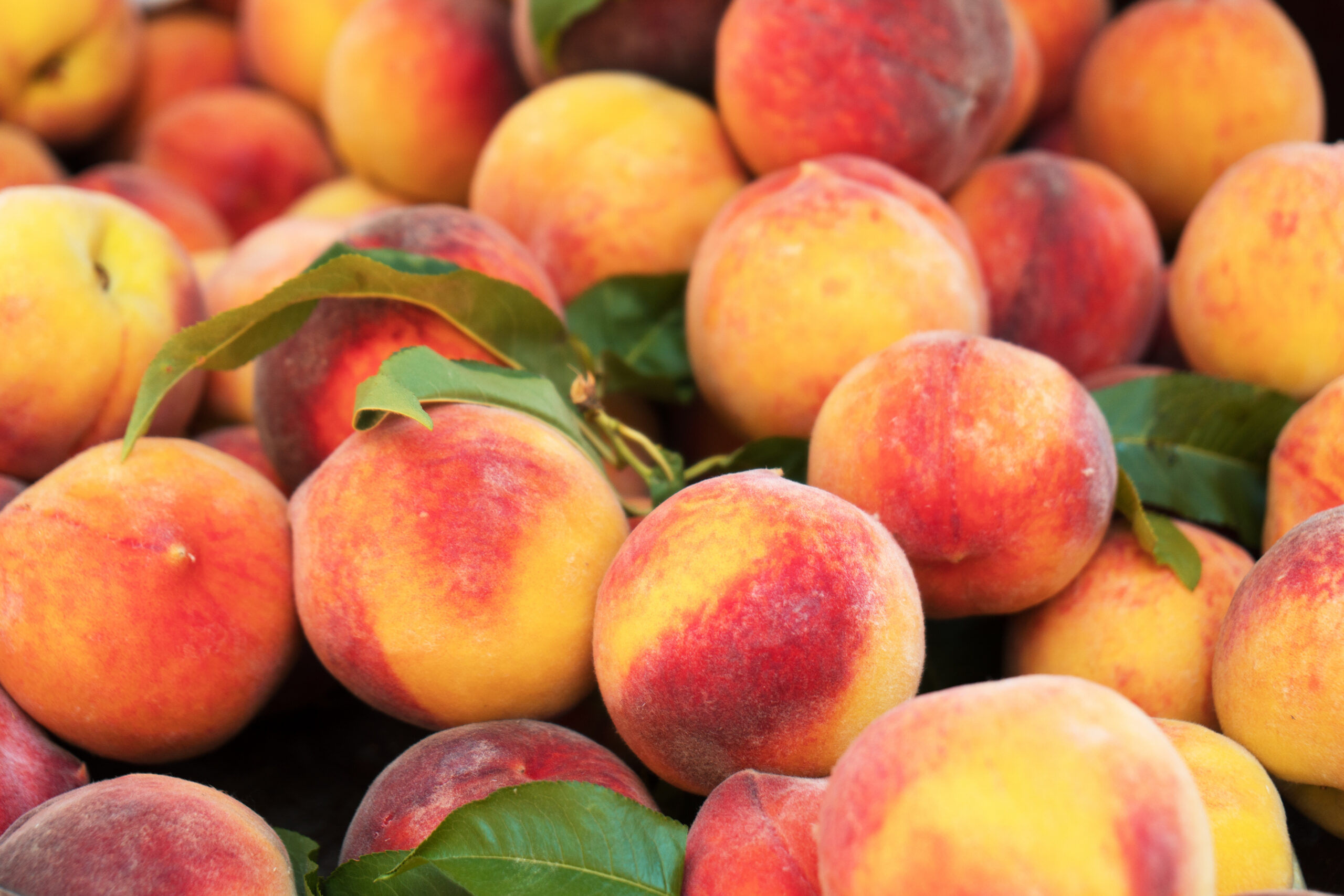
Looking for Louisiana peaches? Here’s why the hunt is just the pits
Local peach enthusiasts used to anticipate the arrival of Waterproof peach farmer Buddy Miller at the Red Stick Farmers Market like kids waiting for Christmas. From his seated perch, the chatty, bespectacled octogenarian wooed fans—and some doubters—with fresh-cut slices at the Thursday and Saturday markets. Long lines formed for Miller’s just-picked fruit, some of which flashed their freshness with sprigs of still attached leaves.
“Mr. Buddy’s” peach sales weren’t a one-time thing. They unfolded over several summer weeks since he gamed his orchard with varieties that ripened in staggered succession. (Regulars knew about this from the typed information slips he enjoyed distributing.)
Miller sold at the market from the early aughts until 2023, when brutally hot temperatures and the exhausting work of hauling peaches, melons and other produce to Baton Rouge got to be too much for the aging farmer. Today, he resides in an assisted living facility in Ruston.
Shoppers have missed chatting with Miller and, of course, having access to his fresh, local peaches, says Darlene Adams Rowland, executive director of market organizer BREADA. Along with watermelons and fresh tomatoes, Louisiana peaches had become a mainstay of the market’s summer identity. These days, they’ve become a sought-after, rare commodity.
“People ask all the time. They want peaches,” Rowland says. “The season was one of the most popular for us. A line would start at Mr. Buddy’s booth at the beginning of the market until he sold out.”
But for several reasons, it’s unlikely the Red Stick Farmers Market will see another peach vendor, Rowland says. Miller was rare in his willingness to drive to Baton Rouge from Tensas Parish, a commitment that included hitting the road at 2:30 a.m., he has said. Meanwhile, a steady decline in the industry brought on by disease and a decline in farming has been brewing for decades, says Alexandria-based LSU AgCenter assistant professor and extension fruit and nut specialist Michael Polozola.
Between the 1930s and 1950s, Louisiana had more than a thousand acres in production. Today, peaches are produced on around 25 acres, he says.
Several factors have contributed to this, including the prevalence of Armillaria root rot, also called oak root rot, a fungus that attacks a peach tree’s root system and is almost impossible to treat.
“It’s really decreased the economic livelihood of an orchard,” Polozola says.
Moreover, the already short lifespan of peach trees has grown even shorter, he adds.
“It used to be that you could get 15 to 20 years out of a tree, but now it’s more like 12,” he says.
Rather than refreshing orchards with younger trees, some farmers have simply phased out operations as older trees cease production.
There’s also the weather. Peaches are notoriously finicky. They need to bank a certain number of so-called chill hours during the winter when temperatures fall between 32 and 45 degrees. Those chill hours are what triggers the trees to bud, Polozola says.
But too much cold will destroy a crop. A mid-March hard freeze this year decimated most of this summer’s Louisiana peaches, says Joe Mitcham of Mitcham Farms in Ruston, one of the state’s last big growers.
“The March freeze wiped out 95% of our crop,” Mitcham says. “We’ve harvested about 150 [25-pound] boxes so far when normally we would have harvested 2,700.”
Mitcham’s father, once Ruston High School’s band director, planted the orchard’s first peach trees in 1947. The farm’s productivity peaked between 1975 and 1985, Mitcham says. But three years of harsh winters between 1986 and 1989 wreaked havoc on north Louisiana peach orchards, beginning a gradual, unstoppable production decline that’s been exacerbated by oat root rot. Mitcham’s family’s orchards have dwindled from about 340 acres to about eight today, he says.
Mitcham used to sell his peaches wholesale to Kroger and Associated Grocers, but today, he sells them direct to consumers through corporate gift orders and his on-site farm store. He still grows 11 different varieties, including Ruston Red, Red Globe, July Prince and Blaze Prince. This year’s bad luck meant having to rely on South Carolina peaches to round out his store’s shelves, something that’s become increasingly more common.
Similarly, this year’s Louisiana Peach Festival, a 76-year-old community staple held in June in Ruston, also had to import fresh peaches from South Carolina to meet demand, he says.
South Carolina is the country’s second largest producer of peaches. California is first.
In fact, peach fans around Baton Rouge will find mostly California peaches on store shelves this time of year, even at locally owned vendors like Southside Produce.
They won’t taste the same as a local peach that’s been recently harvested, Polozola says.
“Nothing tastes better than a peach that is ripe right off the tree,” he says. “You really can’t get that from peaches shipped long distance.”