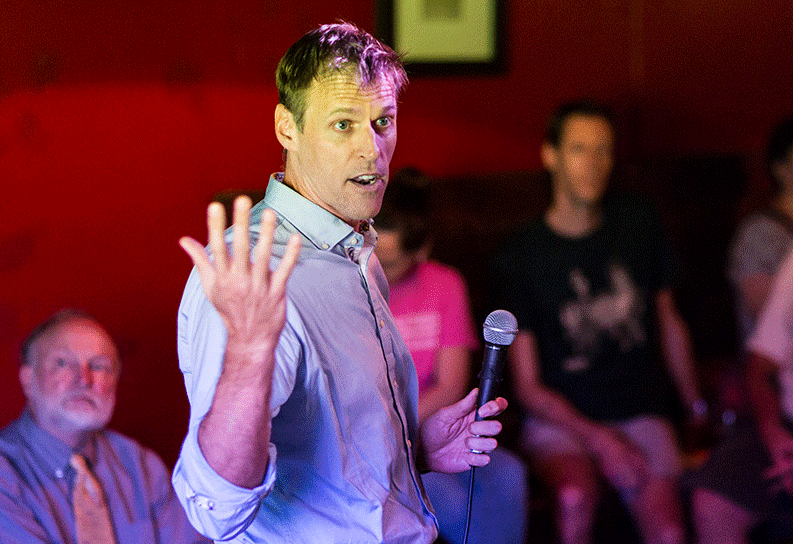
It will take more than additional lanes to fix the BR traffic issue
Content Provided by our sponsor: 
Brian Wolshon is the Edward A. and Karen Wax Schmitt Distinguished Professor of Engineering in Louisiana State University’s Department of Civil and Environmental Engineering and director of the Gulf Coast Research Center for Evacuation and Transportation Resiliency.
Although many people think Baton Rouge’s traffic problems would be solved by adding more lanes, his research proves it isn’t that easy. On Feb. 28, you can hear more of his insights on local traffic when he’s one of the 12 speakers at TEDxLSU 2015.
I connected with Brian recently to learn a little more about his life and passions. Here are the highlights of our conversation.
When did you realize you were called to work as a transportation and traffic engineer?
During my senior year as I was about to graduate with a degree in physics and saw a low potential job market for what I wanted to do and I needed to do something marketable, so reluctantly, I began looking into potential classes in computer science and engineering. To see what the field was like, I sat in on a class about highway design and traffic engineering taught by professor Snehamay Khasnabis and I was immediately interested and inspired. In one class I was able to learn about the science behind something that just seemed random to me before.
What connects you to Baton Rouge?
My family and my kids’ activities, my job at LSU and all the really really good people who I know.
What is your favorite mode of transportation?
As a former competitive cyclist who still enjoys a tough, fast ride, I’d have to say it is my bicycle. But I also love my pickup truck. And, if the weather is good, it’s hard to beat the views from 39,000 feet.
If you could send an invitation to anyone in the community to hear your TEDxLSU talk who would it be?
It would be my students – especially the undergrads taking the required transportation class at LSU. As a professor, it’s fun when I’m able to spark interest in someone who only took the class because they had to, but when they learn about the topic and find out it’s fun and interesting, they want to learn more.
What has been the highlight of your career thus far?
I have had many. Many, many.
LSU has afforded me the opportunity to work on some of the most interesting and challenging projects imaginable here in Louisiana, in states throughout the country and in other countries around the world. But if I had to pick just one, it would have to be my involvement with the Louisiana Department of Transportation and the Louisiana State Police to develop the state’s regional contraflow hurricane evacuation plans.
Through those plans — put in place only weeks prior to Katrina — we were able to facilitate the movement of more people, in a shorter amount of time than had ever been accomplished — or even thought possible prior to that event. The Louisiana plan still serves as a model for cities around the world as to what can be achieved with creative thinking backed by solid engineering and research.
When I say the word “connect” what comes to mind?
To me, “connect” means joining people with creative ideas with lots of dedication and hard work to solve problems and get things done. Don’t sit and talk and think and discuss and complain — just get it done.
If you were to make a change today to make traffic flow better in the LSU community, what would it be?
I have so many colleagues, former students and friends who dedicate their professional lives to make traffic move safer and faster in this community despite the constant constraints of politics, limited budgets, lack of time, and on and on. This topic is too complicated to suggest one change, or two, or even 10 that would solve the problems I see in transportation, but I am grateful for the good work others in my field do every day for real.
To learn more about Brian and TEDxLSU 2015, follow TEDxLSU on Twitter, Facebook and Instagram. Connect with Brian and his fellow speakers on Feb. 28.